07 Jun 2011
I got Tata Photon+ mobile broadband connection during 2010, it worked well initially for a month or two.I can notice, their services have been degrading since then (late 2010).
Connectivity is not an issue, but download speed and latency.
A recent test results done on June 6, 2011


We all know, most of marketing/advertisements campaigns are big lies. There is big disconnect between the idea/dream they show and the reality.
In the case of Tata Photon+, they advertise about giving ‘up to 3.1 mbps’ download speed BUT I am yet to get 1 mbps consistently for an hour, leave alone days.
I guess, this is location specific. Places like Kanpur and other cities in UPE are not given enough of importance (network infrastructure and attention)?
Whenever I complain to Tata Photon Customer Support, someone visits, tests using speedtest.net against Delhi/Mumbai servers, and shows me test results (skewed?) which is generally in range of 600 kbps to 1.2 mbps.
When I show him results of tests done against servers in USA and Europe, they would argue - which reflects their ignorance about technology and terminology (ping, latency, etc.)
Yesterday, I filed another complaint over phone. I got a call asking if I was in front of computer, I said “No, but I would be in couple of hours and tomorrow”. After couple of hours, I got a SMS suggesting my complaint-ticket had been resolved and marked as closed. Really? No one visited me.
I filed another complaint using web-site, got around 10+ calls within 12 hours. All of them asking same question “What’s problem sir”. I don’t understand, why didn’t these guys look at their CRM and read the details (which included the speedtest.net test results)?
Anyway, one of those guys (from some Tata hired agency) visited me today. He repeated the same process of testing against two Indian servers using speedtest.net. This time, he got lucky speed results showed around 1 mbps agaisnt Delhi/Mumbai server. I requested him to visit again tomorrow in afternoon and perhaps at different location.
During middle of meeting, this fellow stood up and walked out. I followed him to ask what happened?
He misbehaved by saying “I heard enough, I am going. That’s all we can do”.
I felt offended, I asked about his details, he denied giving by saying “Do whatever you can”. He left ignoring me.
I feel bad as customer, and also because I have been a Tata employee. I had never expected, one of Tata companies would do such things i.e. poor service and worst customer support (not at phone, but at ground level - those visiting agents).
I feel, I have wasted so many hours talking, thinking and complaining. No one wants to listen and do anything.
Updates:
-
June 24, 2011: I found Tata Photon very slow at my residence, hence filed a fresh complaint (requested that someone should visit me on Sunday at my residence to test speed in that area) via phone. CSR said, they don’t work on Sunday, I said - I can be available on weekdays provided an appointment is taken.
-
June 25, 2011: I received two calls from Tata Photon support team. In both calls, I was asked same question “what is problem, sir?” with one difference, in latter call I was told that they can visit me on Sunday
-
June 26, 2011: I got a call, where I was asked same and some more questions:
- What is problem, Sir?
- Did you buy device with warranty?
- What speed do you get?
I told them, “I am happy with the device but not with the signal and speed in this area (my residence), hence needed someone to visit me and test speed here”. They asked me to go to Tata Photon centre, around 8 kms from my place. I asked, “how can they test issues of this area in different area?”.
They threw another bomb by saying, a fee( INR 75) needs to be paid by customer, if he/she wants technical-support-engineer to visit customer’s place?
I got upset and reminded that this is mobile-broadband. Isn’t it their responsibility to make sure connection signal and quality is good in all areas?
Anyway, that was new, I had not paid such fee earlier.
I asked, when did they start charging? She said, “Yesterday”. I reminded her, I filed complaint day before yesterday. She said, it has been started on June 20, 2011.
I asked her to pass the call to her senior, who ended up saying the same thing. I told them, the policy is ridiculous.
Why a customer has to pay extra to get service related issues checked/fixed? Isn’t customer already paying every month? Isn’t it Tata’s responsibility to provide services as they promise?
I have invested some money and time to get the device and connection; I can switch to different provider, but device might not be reusable unless someone buys it from me.
Once again, I am disappointed by Tata Tele’s services. I am going to move away from them and would not recommend Tata Tele’s services to my family and friends.
More Updates:
-
June 28, 2011: As an last attempt, I wrote an email to Tata Tele Services contact and also copied the same to UP East Nodal Officer.
-
June 29, 2011: I got a call from a senior Engineer, who visited me on the same day. During 3-4 hours long troubleshooting, he figured out the reason behind slow speed, which is, HSIA signals was not as strong as CDMA 1X, and some tower issues.He got an antenna installed, on the roof-top, and connected to my USB device. He promised to get a repeater installed during weekend, so that all devices at our place can get better quality signals.
Once antenna was installed, and some augmentation was done in one of the towers, things improved a bit.
He seemed a good professional and knew the stuff. He earned my respect. I learnt, good guys are very overloaded because someo of their peers don’t do their work properly :-)
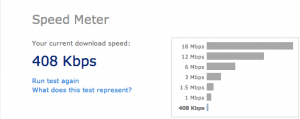
- July 2, 2011: Two Tata Photon smart junior-engineers visited and installed a repeater at our house. The senior engineer kept his word, he earned more respect.I can feel the difference now; Two different tests during last 5 hours have given very positive results, as shown below:


Once again, I gave my feedback about service and the misbehaviour by one of their peers. I am sure, the good-guys would fix things by putting peer pressure and leading by examples.
As far as fee for visit is concerned, I was told by one of the engineers, it is for the cases where customer’s device or computer is found to be faulty, not the service. I wonder, why I was not told the same earlier during the call, which made me upset?
I am going to wait for couple of days. If I get consistently better quality speed, I would strike out the line (about not recommending) above. Anyways, there are some issues with Tata Photon+ customer support and service, which would need to fix, so that all issues can be resolved without any escalation.
Tip: Choose HSIA from network-settings of Tata Photon+ dialer, this would force modem to use to HSIA enabled towers/frequencies and would avoid using CDMA 1X.
06 May 2011
We have been working on some exciting stuff for over last three years, we want to take that to next level. We also have some crazy and cool ideas for new products/saas, we have got enough details figured out to get started.
We want some smart interns to work with us during this summer or longer (perhaps six months or full-time  ) in any or all of following:
- Web Development (goal: build new products or extend existing products)
- Mobile (goal: turn our ideas into reality by building some cools apps and games for iPhone, Android and other mobile-devices)
- Flash Platform (goal: build some cool applications for our existing project)
Summer vacation has started in most of the colleges in India; Some passionate students would want to do something more useful during this time. If you are one of them, why don’t you get in touch with us?
BTW! We are always looking to hire smart and passionate designers and developers for our team. If you are interested into a full-time position, please let me know.
28 Feb 2011
I posted about our proposed development setup, during these years a few things have changed a bit. More or less, this is what we have:
- GNU/Linux (Ubuntu) and Windows(some) boxes for developers
- Eclipse (PDT) IDE with loads some plugins
- Version Control: Subversion, GIT, GIT-SVN
- Browsers
- Firefox
- Chrome
- Opera
- Safari
- OperaMini (Simulator)
- FirefoxMobile (Simulator)
- Plugins for browsers:
- Firebug (with loads of plugins - YSlow, etc.)
- Web Developers Tools (firefox)
- Others (developer’s preference)
- Developers also use WINE to run some windows software on GNU/Linux
Testing:
- Windows Box with different browsers (versions, vendors)
- Windows Box with different Mobile Emulators/Simulators
- Selenium Plugin for Firefox
Development Servers/Applications:
- Apache HTTPD
- Mysql Server
- Trac
- MediaWiki
- PHPMyAdmin
- ReviewBoard (limited usage)
- Hudson (limited usage)
28 Feb 2011
One of our servers, collocated in our office, crashed couple of weeks back. We took this opportunity to virtualize most of the stuff, earlier only some intances were virtualized.
Installing and setting up VMware vSphere Hypervisor is a straight forward process, even the process of creating virtual-machines.
Most of time, I spent was figuring out:
- Storage devices and configuration
- How many virtual machines, do we need?
- Which operating systems, do we need?
- Network configuration
I am not going to cover details of installation and network configuration. I might write more posts in future to cover specifics. Meanwhile, I would love to answer the comments, if I know or share anything I know.
Anyway, this is what we have now:
- IBM x3250 M2
- Intel Xeon (Quadcore) x64
- 4 GB memory
- 3TB+ storage connected to LSI RAID and SATA controller
- Host: VMware vSphere Hypervisor - which runs out of 1.5 TB datastore, directly connected to SATA controller (different from LSI)
- Guest VMs:
- OpenVPN Access Server for VPN
- Ubuntu 10.10 Server as Development sandbox
- Zentyal(eBox) as Internet Gateway (filtering, IDs, proxy)
- Ubuntu 10.04 LTS Server for SVN, Mails, Local Staging WebServer
- Windows 2008 Server for ActiveDirectory, FileServer, Windows-Specific-Software (access-control-management-gui, etc.)
- Others: Project Specific VMs
We are very happy with the improved performance and stability, and the way hardware is properly used. Thanks to VM templates, clones and snapshots, we would be able to provision above infrastructure with minimal downtime.
I would soon replace Windows Server with Zentyal (eBox), which I believe, can handle most of things. However, we would need another Windows XP box to run some software (proprietary), which only runs on windows, to manage various other devices (EPBX, Access-Control-System, etc.).
We now have relatively more scalable infrastructure, more virtual machines can be created to take care of email-server, svn-server, etc.
We are yet to invest in a sophisticated storage device such as DAS or NAS or SAN, hence we are relying on some cheap tricks here:
- 1.5 TB disk as datastore for VMware vSphere, which stores
- Guest Operating System VMs
- Guest Operating System VMs Paging files
- Virtual Disks (non critical data - programs and configs) required by host virtual-machines
- 1.5 TB disk via Raw Device Mapping (RDM) shared among virtual machines
- 500 GB disk via Raw Device Mapping (RDM) shared among virtual machines
- 1.5 TB USB/Firewire - Backup storage
- Rsync is used to backup critical data and configs from all virtual machines on daily, weekly and monthly basis.
Things I didn’t like:
- VMware vSphere client requires Microsoft Windows
- VMware vSphere client doesn’t allow creating RDMs from GUI, one has to use these instructions
Finally, I could execute some of things I planned more than two years back.
28 Feb 2011
Entrepreneurship Cell (E-Cell), at IIT Kanpur, is organising TEDxIITKanpur event on March 12, 2011. This is the first event of it’s kind, and I hope we would have more of those (TEDx, BarCamp, DevCamp, etc.) in Kanpur (within IITK campus or outside).
Our company (Allies Interactive Services) is honoured to contribute as design sponsor of TEDxIITKanpur, and hopefully other events organized by E-Cell, IIT Kanpur.
28 Feb 2011
The Adobe Flash Platform runtimes team has launched Adobe AIR and Flash Player Incubator program, which would showcase bleeding-edge, under-development or under-consideration features of Adobe AIR and Flash Player builds.
Unlike Adobe pre-release program(s), Incubator program is open to everyone, and encourages companies and developers to look at under development features, and also give feedback to shape the future of these runtimes.
This launch is another major milestone, after Adobe Labs and Open Source initiatives by Adobe. We are heading in right direction.
“Molehill” 3D APIs and Cubic Bezier Curves are the first two features available in incubator build. I am sure, there would be more features available in coming months.
BTW! These early features might not make to final release of runtimes, as it’s always case with
Visit Adobe AIR and Flash Player Incubator’s page on Adobe Labs to learn more. You can also subscribe to new Adobe Flash Platform Runtimes releases blog to get real-time updates on new AIR and Flash Player releases.
26 Feb 2011
Jamie Murai has written an open letter to RIM, the company behind Blackberry and Playbook. Jamie talks about his experience of setting up development environment for Playbook application development.
It seems, RIM has failed to attract developers, the credit goes to broken development process and tool-chain. One has to spend good amount of time (and money?) setting up development environment, building application and deploying the same to marketplaces.
Why would developers bother looking at Playbook development, when they have better options (iOS and Google Android), where development, deployment and monetization is relatively very-very simpler.
Developer usability is very important. Any company that relies on developer community/ecosystem for their growth, should take some lessons from Jamie Murai’s open-letter, which enlists some important points/issues.
Read Jamie Murai’s Open Letter To RIM’s Developer Relations.
25 Jan 2011
One of our projects requires a calendar application with bi-directional synchronization with any other calendar applications/services such as Microsoft Outlook, Mozilla Thunderbird, Google Calendar, Yahoo! Calendar, iPhone, Nokia or others.
We can export iCalendar file, that would be readonly i.e. client applications can not write back to source calendar
I started looking at CalDAV, which is an extension to WebDAV, and SyncML, which is gaining traction because most of the mobile devices use it for synchronization of data. I yet to find where CalDAV fits when it comes to mobile devices.
I found out some interesting links, which I am still going through. I thought, it would be nice to share these links:
12 Jan 2011
It appears to me (and perhaps others), I have distanced myself from Adobe Flash Platform during last couple of years. Not because I don’t like it, actually I love it, rather due to some other priorities here at our company, which does lot more (web-standards and design) than flash/flex stuff.
All this time, I have been keeping very low profile in flash-platform community, literally not talking about anything. I feel bad about it, I don’t know ‘why’.
I have done some trivial stuff (video players, flashlite and air apps) but nothing very cool or useful to everyone else.
My to-do list contains a long-list of applications targeted towards Adobe Flash Platform (desktop and other devices), I am supposed to do; Considering, my plate is full with all other responsibilities, I am not spending even 1/4^th^ of the time writing actionscript.
Meanwhile, I have tried to encourage my team to learn actionscript and flex-framework. I even tried to hire some flash (or flex?) developers. I even managed to hire one flex developer last year.
Unfortunately, this person left the company as soon as when it was time to contribute back after 6 months training (no contribution period). That was big set back, a discouragement to me; I stopped looking for Flash/Flex developers.
I keep on promising myself, that I would do these applications; I keep on forgiving myself when I am not getting those done.
Anyway, there is still hope, I would building applications the on language (ActionScript), I am very good at. There is still hope, this blog would have more posts related to Adobe Flash Platform.
12 Jan 2011
We use Trac as project collaboration space[1] within our company. We have been trying out agile-methodology (specially Scrum) for projects, but recently we went more formal with the approach using a software to manage the whole process.
I evaluated some software for agile project management and found good ones including ThoughtWorks’ Mingle, but it’s not open-source and I believe, we can’t afford it (licensing, subscription).
We found ‘Agilo’, a plugin for Trac, is easy to setup and was intuitive enough to get us started, considering our (no) experience with formal agile-methodology.
Do you want to get started with Scrum and don’t want to invest time learning a complicated software? You don’t need a software to do Scrum. However, if you like managing projects using a software and you are comfortable with Trac, try Agilo.
You might want to check Scrum in five minutes [PDF]
BTW! This is yet another post to spread the word about the software and tools, we find useful and have been using.
[1] project management, bug tracking, documentation, wiki and version-control browser